Research

Natto which is produced by Bacillus subtilis is a representative Japanese traditional food. Wine and beer produced by yeast are familiar to many people all over the world. Furthermore, several microorganisms are applied to waste water treatment and this job is one of the most important duty to maintain ecosystem in this planet. If they were disappeared, we would be absent on earth. So, our life is apparently supported with many microorganisms. From the viewpoint, our research policy is to clarify several dynamics of their life. Moreover, to advance our study, we manage microorganisms which are powerful and effective tool for new finding.
Here, we introduce our research.
- 1)DyP-type peroxidase family and molecular evolution
-
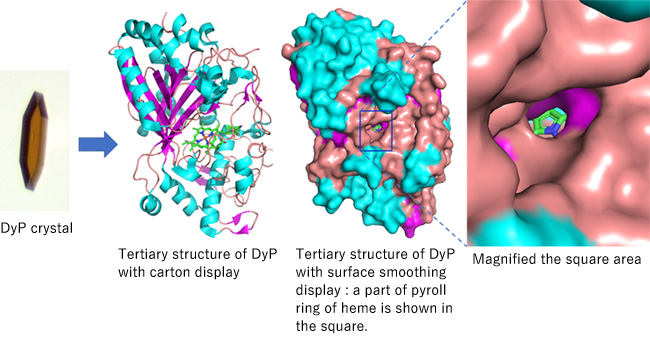
- DyP is a representative DyP-type peroxidase, which was isolated and cloned from a basidiomycete Bjerkandera adusta. DyP shows a typical peroxidase activity, but the structural folding is quite different from ubiquitous haem peroxidases. Therefore, in early stage of this research, DyP is considered to be an exceptional haem peroxidase. Nowadays, DyP-like peroxidase is found to be a large group of haem peroxidase, and named to DyP-type peroxidase family (Sugano, Y. et al. J. Biol. Chem. 282(50), 36652-36658, 2007). Here, we introduce the recent our research for DyPs from several sources. In 2015, we proposed a new classification of DyP-type peroxidase family (A structural and functional perspective of DyP-type peroxidase family. Arch. Biochem. Biophys. 574, 49-55, 2015.), that is, classes P, I, and V. This classification depends on both primary structure and tertiary structure homologies, suggesting resolution of ambiguity between former classes C and D. In our study, the substrate binding site and a probable electron transfer route toward DyP from Bjerkandera adusta have been proposed (Yosida et al. FEBS Lett. 2012). Although the new classification for DyP-type peroxidase family is confirmed, the physiological role of them is unknown yet. However, recently, we have clarified that degradation of antifungal anthraquinone compounds is probable physiological role of DyP secreted by Bjerkandera adusta (AMB Express, in press, 2019). Another focus is that DyP-type peroxidase family is very important material to predict a convergent evolution of protein. So far, the concept of convergent evolution for protein is obscure. However, several research data seems to support that DyP-type peroxidase family has been formed by the results of convergent evolution. This is the first actual example for a convergent evolution of protein. We further continue to research DyP-type peroxidase.
- 2)Bacterial cellulose is a natural cellulose nanofiber
-

Top; Static culture of Gulconacetobacter xylinus. Cellulose pellicle is produced on the surface of the culture medium. Bottom left; Colonies of G.xylinus with Calcofluor white under UV light, Bottom right; Electron-micrograph of bacterial cellulose nanofiber produced by G.xylinus. The average width of the nanofiber is 50 nm. - Bacterial cellulose is also exciting research theme. The molecular structure, (C6H10O5)n is identical to that of plant cellulose. However, the quality is far more superior to that of plant cellulose because bacterial cellulose has never contained impurity thoroughout its biosynthesis. Moreover, the width of the fiber is about 50 nm, indicating natural nanofiber. The biosynthesis units are at least formed with 4 subunits, that is, BcsA, BcsB, BcsC, and BcsD. Their complex is called terminal complex. BcsA and BcsB are located in inner membrane and peliplasmic space, respectively. On the other hand, the location of BcsC and BcsD are obscure. Moreover, other units (CMCase, ORF2, glucosidase) are of importance for the quality of the synthesized cellulose. From the viewpoint, to clarify the mechanism of the synthesis of bacterial cellulose is attractive both industrial and academic interests. In our lab, we are trying to clarify the synthetic mechanism by versatile approach with Gluconacetobacter xylinus. Especially, we are trying to express BcsC, which is the largest subunit of terminal complex, using by a fungus. If the structure of BcsC is confirmed, the role of BcsC on the cellulose synthetic mechanism will be clarified, solving the whole process to produce cellulose nanofiber.
- 3)A place of frontier
-

Left;microbial colonies from a natural soil, right;sampling at a tidal flat -
Screening from the natural habitat is one of the most important work for our laboratory. Originality and priority are resources and driving force to accelerate lab research. Actually, the novel enzyme, α-neoagaro-oligosaccharide hydrolase (EC 3.2.1.159) found by myself, was based on a screening from seawater. DyP is also novel enzyme (EC 1.11.1.19) and its producer has been isolated from natural soil. Both enzymes are milestone for our laboratory because their research studies by us are referred from many researchers in the world to this day. Therefore, we do believe such a screening is a seed of a new research and continue to hunt a useful but unknown microorganisms from the natural field. Our new findings and topics will be presented in “News” and “Archives” pages.
Thank you for your attention and don’t hesitate to contact me if you’d like to join or collaborate with our laboratory.